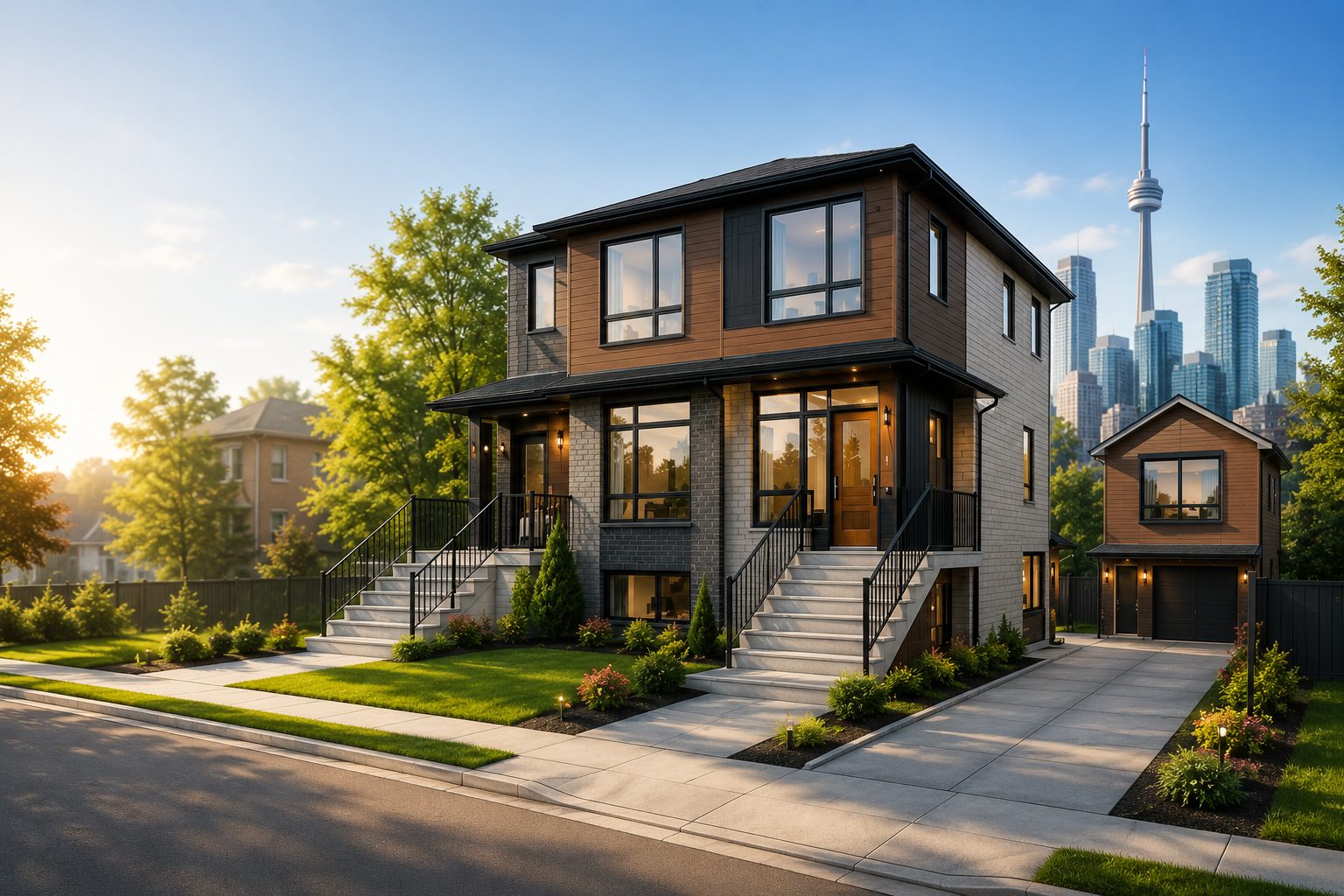
Toronto's residential neighbourhoods are changing. More homeowners are realizing their property is not just a place to live — with the right plan, it can legally generate rental income while qualifying for insured financing.
The real question is: which CMHC financing path is right for you? This guide walks through the two main options with practical Toronto examples and clear numbers.
- Why now is a good time for multiplex projects
- The core difference: 1–4 units vs 5+ units
- Path 1 — CMHC Refinance (owner-occupiers)
- Path 2 — Construction Financing + MLI Select (investors)
- Which path is right for you? Five questions
- Quick comparison
- Three things to do before you choose
- Final thoughts
Why Now Is a Good Time to Explore Multiplex Projects
Toronto introduced its Expanding Housing Options in Neighbourhoods (EHON) policies in 2024–2025. In many low-density residential areas, homeowners can now create up to six units without a separate planning approval. At the same time, the federal government has expanded CMHC-insured financing for smaller multiplex projects.
In simple terms, the house you already own may now offer a new opportunity: more housing, more rental income, and better financing. But there are two very different financing paths, and choosing the wrong one can significantly affect your cash flow, risk, and long-term flexibility.
The Core Difference Between the Two Paths
Before comparing them, understand one key point: CMHC financing works very differently for properties with 1–4 units and properties with 5 or more units.
| Residential CMHC (1–4 Units) | Commercial MLI (5+ Units) | |
|---|---|---|
| Main qualification basis | Your personal income | Property rental income & DSCR |
| Maximum loan-to-value | 90% LTV | 95% LTV |
| Maximum amortization | 30 years | 50 years |
| Construction funding | Approved before construction, released in stages | Usually refinanced after construction |
| Property value limit | $2 million after improvements | No value limit |
| Owner-occupancy required | Yes | No |
Path 1: CMHC Refinance
Best for homeowners who plan to live in the property
This CMHC refinancing option is designed for owner-occupied homes. It may let you add one or two separate rental units to your existing property, as long as the finished property has no more than four units. The refinanced mortgage can be used to cover the construction cost.
A homeowner bought a semi-detached house in 2019 for $950,000. It's now worth about $1.3M, with $580,000 remaining on the mortgage. The plan: convert the basement into a legal two-bedroom suite ($120,000) and build a two-bedroom garden suite ($450,000) — a total construction budget of $570,000.
Financing: As-improved value ≈ $1.75M. Max CMHC refinance = $1.75M × 90% = $1.575M. Less the existing $580K mortgage leaves ~$995,000 in new financing — more than enough to cover the $570K build.
Cash flow after completion: basement suite ~$2,200/mo + garden suite ~$3,200/mo = ~$5,400/mo in rent. The added mortgage payment (on $995K, 25-yr, 5.5%) is roughly $6,100/mo — so rent covers about 88% of it. The owner's out-of-pocket cost is under $700/month while living in a ~$1.75M property.
Advantages
Approval can happen before construction. Funds are released in stages as work progresses, so you don't pay the full build cost upfront or rely on expensive private financing.
Lower insured residential rates. CMHC-insured residential rates are often 0.50%–1.00% below commercial rates — roughly $5,000–$10,000 in annual interest savings on a $1M mortgage.
Cleaner tax structure. Your principal residence may stay eligible for the principal-residence capital-gains exemption, while rental-portion expenses (allocated interest, maintenance, depreciation) may be deductible. Confirm with an accountant.
Simpler process. Fewer commercial requirements — usually no full DSCR analysis, commercial appraisal, or energy documentation. Approval often takes about 30–45 days.
You keep owner-occupancy benefits. You keep living in your home while rental income covers most of the mortgage — the classic Toronto “house hacking” strategy.
Limitations
The $2 million value cap is a real constraint. The finished value must stay below $2M. In areas like Riverdale, Leslieville, and parts of Etobicoke, many homes are already worth $1.3–$1.6M, and adding units can quickly push the as-improved value past $2M. Get an “as-improved” appraisal estimate before you start.
Qualification depends on personal income. Approval is based on GDS/TDS ratios, with the stress test using the higher of your contract rate + 2% or 5.25%. A ~$1.3M total mortgage may require household income around $180,000–$220,000+, depending on your full profile.
Amortization is capped at 30 years. Versus a 50-year commercial amortization, this means higher monthly payments and more cash-flow pressure.
You must live in the property. You or an immediate family member must occupy one unit — it is not for pure whole-property investment.
Four units maximum. You cannot access the 5+ unit commercial MLI system, with its higher LTV and longer amortization.
Path 2: Construction Financing + MLI Select Refinance
Best for investment-focused owners
This is a two-stage strategy commonly used by investors:
1. Use a conventional construction loan or private financing to complete the project. 2. Create a five-unit or larger rental property — often a “4+1” model with four units in the main house plus a garden or laneway suite. 3. Once the units are complete and rented, refinance with CMHC MLI Select based on the property's rental income.
The refinance can repay higher-cost construction debt, reduce interest, extend amortization, and potentially release equity for the next project.
An investor buys a detached house for $850,000 and spends ~$650,000 to create five legal rental units (four in the main house + one laneway suite). After completion, rent is $11,000/month.
MLI Select refinance: after a 30% operating-cost allowance, net operating income is ~$7,700/mo, or $92,400/yr. At a 5% cap rate, value ≈ $92,400 ÷ 5% = $1.85M. At 90% LTV that's $1.665M. Less the $1.5M total acquisition + construction cost, potential equity released is about $165,000 — and more if the project earns a higher MLI Select score and qualifies for up to 95% LTV.
Advantages
Qualification is based mainly on rental income. MLI Select looks at the property's ability to support debt via rent, measured by DSCR (NOI ÷ annual debt payments). A major advantage for owners with lower employment income but strong post-redevelopment rents.
Higher LTV and longer amortization. Up to 95% LTV and up to 50 years — for the same $1.5M mortgage, that can cut the monthly payment by roughly 20–30% versus residential terms.
No owner-occupancy requirement. The whole property can be rented — useful if you already have a primary residence and want a dedicated rental asset.
No $2 million value ceiling. There's no equivalent post-improvement value cap, making this route better suited to higher-value neighbourhoods and larger projects.
Refinance and reinvest. After stabilization, MLI Select refinancing may let you pay out construction debt and recycle released equity into the next project.
Limitations
Construction-stage financing is more expensive. CMHC insurance generally does not fund the construction phase here. Expect a traditional construction loan at ~7–9% or private financing at ~8–12%. Carrying costs can be significant if the build or lease-up runs long.
You need more upfront capital. A five-unit conversion can easily run $550,000–$800,000+, and you must carry it without CMHC progress draws. Strong liquidity, home equity, or other capital is essential.
The refinance amount isn't guaranteed. MLI Select refinancing relies on a commercial appraisal using the income approach. If rents underperform, vacancy is high, rates move, or cap rates rise, the appraised value — and your refinance — may fall short.
The process is more complex. Expect a third-party commercial appraisal, energy-efficiency documentation, DSCR analysis, and a qualified lender. Timelines can run two to six months.
Premiums increased after July 2025. MLI Select moved to risk-based pricing in July 2025. On a $2.5M loan at 95% LTV, 45-year amortization, 70-point score, the premium may be ~$143,000 (versus ~$82,500 under the previous structure). It can usually be added to the loan, but it raises total debt and interest.
Which Path Is Right for You?
Five questions to find the better fit.
1. What is your property worth today? If the as-improved value will likely exceed $2M, Path 1 may not be available — consider Path 2 or other commercial financing.
2. What is your household income? Path 1 leans heavily on personal-income qualification; a $1.2–$1.5M final mortgage may need ~$180,000–$220,000+ household income. Path 2 focuses on rental income and property cash flow.
3. Do you plan to live in the property? Path 1 generally requires owner-occupancy. If you live elsewhere or plan to move out, Path 2 is more flexible.
4. How much upfront capital do you have? Path 1 needs less (sometimes $20,000–$50,000 in reserves). Path 2 may require $400,000–$800,000 in liquidity, equity, or construction financing capacity.
5. Steady wealth-building or faster growth? Path 1 is more conservative — best for building value in one long-term property. Path 2 is more aggressive — better for investors who want to refinance, release equity, and build a portfolio.
Quick Comparison
| Path 1: CMHC Refinance | Path 2: Construction + MLI Select | |
|---|---|---|
| Best for | Owner-occupiers with stable income | Capitalized investors seeking growth |
| Final unit count | 3–4 units (incl. owner) | 5+ units |
| Upfront capital | Low | High |
| Personal income requirement | Higher | Lower |
| Construction-stage cost | Lower | Higher |
| Property value limit | $2M after improvements | No limit |
| Maximum LTV | 90% | 95% |
| Maximum amortization | 30 years | 50 years |
| Owner-occupancy | Required | Not required |
| Process complexity | Lower | Higher |
| Risk level | ★★☆☆☆ | ★★★★☆ |
Before You Choose Either Path, Do These Three Things
1. Get an “as-improved” appraisal estimate. Before construction, spend ~$500–$800 on an estimate from a qualified appraiser. It tells you whether Path 1 stays below the $2M cap, or whether Path 2 can refinance enough to cover the project.
2. Work with a broker who understands multiplex projects. Not every broker handles Toronto multiplex financing. Find one who regularly works with CMHC, small rental projects, garden and laneway suites, and commercial refinancing — and ask for a full two-stage model: construction-period cash flow, final rental income, operating expenses, refinance amount, and stabilized monthly payments.
3. Confirm zoning and permits first. Use the City of Toronto zoning system to confirm how many units your lot allows. Laneway and garden suites have their own rules for lot size, access, setbacks, and separation — confirm them before hiring an architect or investing in design work.
Final Thoughts
There is no single “best” path. The right one depends on your income, property value, available capital, risk tolerance, and long-term goal.
Path 1 is about lower risk and a simpler process — for homeowners who want their house to generate income while they live there. Path 2 is about leverage and expansion — more capital, planning, and construction-stage risk, but greater flexibility and portfolio growth after refinancing. Both can work; the key is to understand the numbers before you start.
This article is based on CMHC policies and Toronto market data as of June 2026. It is for general information only and is not financial, tax, or legal advice. Speak with a licensed mortgage broker, accountant, lawyer, and qualified project team before making a decision.