The HVAC Challenge in Garden Suites
Garden suites present a unique HVAC challenge. Unlike a full-sized house, an ARU is a compact, self-contained dwelling — typically 400 to 1,000 square feet — that needs to deliver year-round comfort with limited mechanical space. In most one-storey and two-storey suites built on a slab or crawl space, there's simply no basement utility room. That constraint shapes every equipment decision.
Ontario's climate adds another layer of complexity. Winters regularly drop below –20°C, and summer humidity pushes cooling demand well into August. Whatever system you choose needs to handle both extremes efficiently.
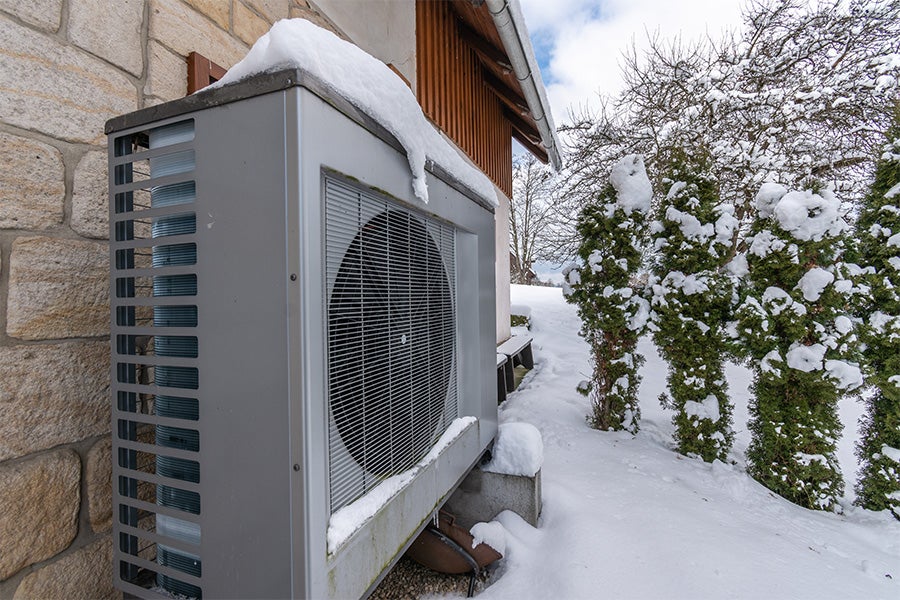
For Suites Without a Basement: The Cold-Climate Heat Pump
Why We Recommend Heat Pumps for Slab-on-Grade ARUs
One system, two functions. A heat pump provides both heating and cooling from a single outdoor unit, eliminating the need for a separate furnace and air conditioner. In a compact suite with limited mechanical space, this is a significant advantage — it frees up interior square footage for living rather than equipment.
Exceptional efficiency. Modern heat pumps don't generate heat — they move it. Even in cold air, there's thermal energy available to extract. A quality cold-climate heat pump delivers 2.5 to 3.5 units of heat for every unit of electricity consumed — that's 250–350% efficiency. Even the best electric baseboard heaters max out at 100%.
No gas line required. Many ARU sites don't have gas service extended to the backyard. Running a new gas line can cost $2,000–$5,000+ depending on distance and trenching. A heat pump runs entirely on electricity, eliminating this cost and the associated permits.
Performance in Ontario Winters
The biggest question homeowners ask: Can a heat pump really keep up in a Canadian winter?
The short answer is yes — if you specify the right equipment.
Older heat pump technology lost significant capacity below –10°C and became essentially useless below –15°C. That's no longer the case. Current cold-climate heat pumps from manufacturers like Mitsubishi (Hyper-Heating), Fujitsu, Daikin, and LG are rated for continuous operation down to –25°C to –30°C, with meaningful heating output even at extreme temperatures.
For Ontario ARU projects, we specify units rated to at least –22°C at full capacity. At this design temperature — which covers the vast majority of winter hours in the GTA — the heat pump handles the full heating load without backup.
On the handful of nights each winter when temperatures dip below –22°C, most cold-climate units continue to operate, though at reduced efficiency. For those rare hours, we recommend installing electric baseboard heaters in key living areas as a backup heat source. Baseboards are inexpensive to install ($200–$600 per zone), require no ductwork, draw modest power, and sit idle for 99% of the heating season — they only activate during brief extreme cold events when the heat pump needs supplemental support. Because these episodes are infrequent and short-lived, the seasonal impact on energy costs is minimal, but the backup ensures the suite never drops below a comfortable temperature even on the coldest nights.
Heat Pump Configurations for ARUs
Ductless mini-split — The most common configuration. One outdoor compressor connects to one or two wall-mounted indoor units. Ideal for open-plan one-storey suites. No ductwork needed, installation is straightforward, and zoning is automatic.
Multi-zone mini-split — For two-storey suites or layouts with separate bedrooms, a single outdoor unit can serve 2–4 indoor heads. Each zone has independent temperature control.
Ducted mini-split — For homeowners who prefer a clean ceiling without wall units, a small ducted air handler can be concealed in a closet or bulkhead, distributing conditioned air through compact ductwork. This is a good option for two-storey suites where a single wall unit on the main floor may not adequately reach upper bedrooms.
Heat Pump Cost Considerations
| Item | Cost |
|---|---|
| Cold-climate heat pump system (installed) | $8,000 – $15,000 |
| Baseboard heater backup (per zone) | $200 – $600 |
| Annual operating cost vs electric baseboard | 30–50% less |
That upfront cost is often comparable to or less than the combined cost of a gas furnace, air conditioner, gas line extension, and associated ductwork. The Greener Homes Grant and various municipal incentive programs may also offset a portion of the installation cost.
For Suites With a Basement: The Gas Furnace Advantage
When Gas Makes More Sense
If your garden suite includes a basement — increasingly common as homeowners maximize liveable space and rental income — the HVAC equation shifts in favour of a traditional gas furnace and central air conditioner.
Dedicated mechanical space. A basement provides a proper utility room for a furnace, water heater, and electrical panel. There's no need to sacrifice main-floor living space for equipment, and servicing is straightforward.
Rock-solid winter heating. A high-efficiency gas furnace (96%+ AFUE) delivers consistent, powerful heat regardless of outdoor temperature. At –25°C or –30°C, a furnace produces the same BTU output as at 0°C. There's no capacity reduction, no defrost cycles, and no reliance on electric backup. For a suite with a below-grade space that needs reliable warmth to prevent moisture issues, this consistency matters.
Lower energy costs. Ontario's natural gas prices remain significantly lower than electricity per unit of energy. For a basement suite with substantial heating demand — both above-grade and below-grade — gas heating typically delivers lower annual operating costs than an all-electric system.
Simpler cooling. With ductwork already in place for the furnace, adding central air conditioning is a straightforward coil-and-condenser installation.
Typical Basement ARU HVAC Package
| Component | Cost |
|---|---|
| High-efficiency gas furnace (96%+ AFUE) | $3,500 – $5,500 |
| Central air conditioner (coil + condenser) | $3,500 – $5,500 |
| Ductwork (new construction) | $2,000 – $4,000 |
| Gas line extension to suite | $2,000 – $5,000 |
| Total installed | $11,000 – $20,000 |
The higher upfront cost compared to a heat-pump-only system is offset by lower operating costs over the life of the equipment, particularly for larger suites with basements where heating demand is significant.
Hot Water: Matching the System to the Utility
Hot water is often an afterthought in ARU planning, but it's a meaningful contributor to both utility costs and occupant comfort.
Electric-Only Suites: Tank Water Heater
For suites without gas service — which includes most heat-pump-heated ARUs — we recommend a conventional electric storage tank water heater.
Why a tank, not tankless? Electric tankless water heaters demand enormous instantaneous power — typically 120 to 150 amps at 240V. For a garden suite on a 100-amp electrical service, that's simply not feasible. A tank water heater draws a modest 15–25 amps, heating water gradually and storing it for on-demand use.
Sizing: For a one-bedroom suite (1–2 occupants), a 20–30 gallon tank is typically sufficient. For a two-bedroom suite (2–4 occupants), we recommend a 30–40 gallon tank. Oversizing wastes standby energy; undersizing means cold showers.
Efficiency upgrade: heat pump water heater. For suites with adequate ceiling height (usually in a basement or large utility closet), a heat pump water heater extracts heat from surrounding air to heat water at 2–3× the efficiency of a standard electric tank. The trade-off is higher upfront cost ($2,000–$3,500 vs $800–$1,500) and more installation space.
Suites With Gas: Tankless Water Heater
When natural gas is available, a gas tankless (on-demand) water heater is the clear winner.
Unlimited hot water. A tankless unit heats water as it flows — no tank to run empty. For a rental suite where occupant behaviour is unpredictable, this is a practical advantage.
Compact footprint. A wall-mounted tankless unit is roughly the size of a small suitcase. It fits in a utility closet, laundry area, or basement wall without consuming floor space.
Energy savings. Only fires when a tap is open — no standby loss from keeping a tank warm 24/7. Typically 15–30% lower water heating costs compared to a conventional gas tank.
Sizing: A unit rated at 120,000 – 150,000 BTU (roughly 6–8 GPM at a 40°C rise) comfortably handles simultaneous shower and kitchen use in Ontario's cold groundwater conditions.
Hot Water Summary
| Scenario | Recommendation | Cost Installed |
|---|---|---|
| Electric only, 1-bed suite | 20–30 gal electric tank | $800 – $1,500 |
| Electric only, 2-bed suite | 30–40 gal electric tank | $1,000 – $1,800 |
| Electric, with space | Heat pump water heater | $2,000 – $3,500 |
| Gas available | Tankless gas water heater | $2,500 – $4,000 |
Ventilation: The Forgotten Piece
Regardless of HVAC system, the Ontario Building Code requires a Heat Recovery Ventilator (HRV) in all new residential construction, including ARUs. An HRV continuously exhausts stale indoor air and brings in fresh outdoor air, recovering 70–80% of the heat energy in the process.
This isn't optional — it's code-required and essential for air quality in a tightly sealed modern building. Budget $1,500 – $3,000 installed for an appropriately sized HRV.
Quick Decision Guide
Heat pump + electric tank water heater. The simplest, most space-efficient setup. One outdoor unit handles heating and cooling; a compact tank handles hot water. All-electric, no gas line needed. Baseboard heaters in key rooms for extreme cold backup.
Heat pump + tankless gas water heater. Use the heat pump for its superior heating/cooling efficiency, but take advantage of gas for unlimited, efficient hot water.
Gas furnace + AC + tankless gas water heater. The basement gives you mechanical space for a full ducted system. Gas furnace delivers the most reliable and cost-effective heating for the larger volume, and tankless gas provides endless hot water.
Every ARU project is different. Lot orientation, suite size, number of bedrooms, rental vs family use, existing gas infrastructure, and electrical service capacity all influence the optimal design. We evaluate these factors during the design phase — not as an afterthought during construction — so the mechanical system is properly sized, efficiently laid out, and code-compliant from day one.