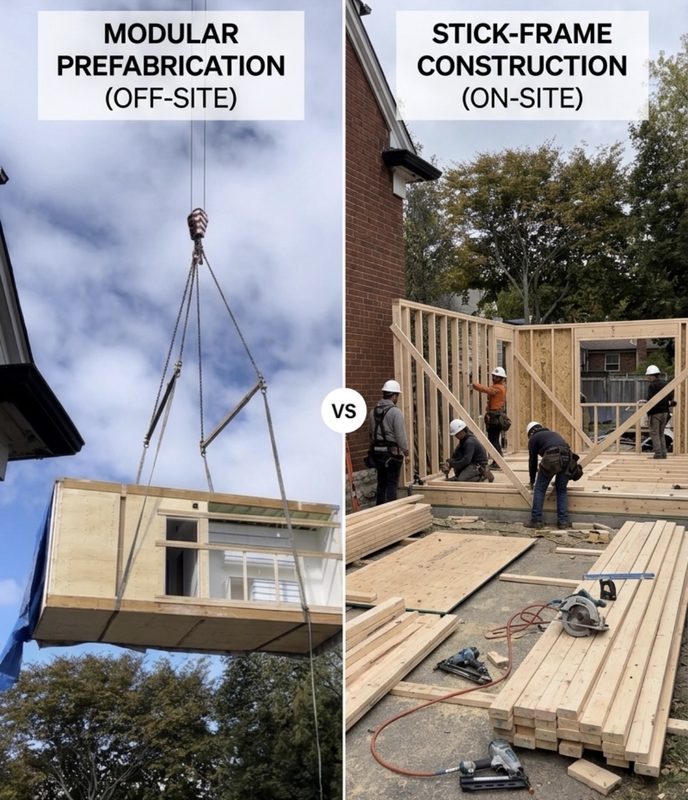
If you're planning a garden suite in the GTA, one of the first decisions you'll face is how to build it. Should you go with a prefab (modular) unit manufactured off-site and craned into your backyard? Or a traditional site-built (stick-built) approach where everything is constructed right on your property?
How They're Built: Two Very Different Processes
Site-Built (Stick-Built)
A site-built garden suite is constructed from the ground up on your property — exactly the way a traditional house is built. The process follows a familiar sequence: excavation and foundation, framing walls and roof structure, mechanical rough-ins (HVAC, plumbing, electrical), insulation and drywall, interior finishes, exterior cladding, and final inspections.
Every step happens on your lot. Inspectors visit at each stage. The build adapts in real time to site conditions — soil type, grading, setbacks, tree protection zones, and the exact dimensions of your backyard.
Prefab (Modular)
A prefab garden suite is manufactured in a factory, usually in one or two large sections. The modules are built indoors on an assembly line, then transported by truck to your property and lifted into place by crane.
The on-site work is limited to: foundation preparation (must be done before delivery), crane placement of modules, joining and sealing sections, utility connections (water, sewer, electrical, gas), minor exterior finishing, and final inspections. The factory handles most of the construction. The on-site phase is shorter — typically a few days to a couple of weeks for the structure itself.
Materials & Build Quality
Site-Built
Materials are selected project by project. You have full control over every component — framing lumber, insulation type, window brands, roofing, siding, kitchen cabinetry, and bathroom fixtures. If you want upgraded spray foam insulation, triple-pane windows, or a specific tile from a local supplier, it's straightforward.
Quality depends heavily on the builder and trades. A good general contractor with experienced sub-trades will deliver excellent results. The work is fully visible to inspectors at every stage.
Prefab
Factory-built modules use standardized materials optimized for the manufacturing process. Quality control in a factory environment can be very consistent — no weather delays, no rain-soaked lumber, and workers specialize in repetitive tasks.
However, material choices are typically more limited. Most prefab manufacturers offer a set menu of finishes and configurations. Customization is possible but adds cost and lead time. Structural design must also account for transportation stresses — the module needs to survive a highway journey and a crane lift without damage, which can influence wall thickness and framing choices.
Cost Comparison
The common perception is that prefab is cheaper. The reality is more complicated.
Prefab Costs
| Item | Cost |
|---|---|
| Unit price (module itself) | $250–350/sq ft |
| Foundation (precision-engineered) | $15,000 – $30,000 |
| Transportation (distance, permits, escorts) | $3,000 – $8,000+ |
| Crane rental (single-day lift) | $5,000 – $8,000 |
| On-site finishing (connections, sealing, touch-ups) | $10,000 – $25,000 |
| Permits & design | $8,000 – $12,000 |
| Typical total (600 sq ft) | $200,000 – $280,000 |
Site-Built Costs
| Item | Cost |
|---|---|
| Design & permits | $8,000 – $12,000 |
| Full construction (foundation to finishes) | $350–400/sq ft |
| Site prep and servicing | Included in per-sq-ft pricing |
| Typical total (600 sq ft) | $200,000 – $250,000 |
Prefab is not necessarily cheaper. Once you add transportation, crane costs, foundation engineering, and on-site finishing, the total project cost is often comparable to — or even higher than — a well-managed site-built project. Prefab can save money in areas with very high local labor costs or where the factory is nearby, minimizing transportation expenses.
Transportation & Access: The Make-or-Break Factor
This is the single biggest practical difference between the two approaches — and the reason we recommend site-built for most GTA urban properties.
The Prefab Delivery Challenge
A prefab module for a garden suite is typically 12–16 feet wide and 30–40 feet long. Moving it requires:
Wide-load truck permits from the province and every municipality along the route. Escort vehicles (sometimes police escorts for oversized loads). A crane large enough to lift the module over your house and into the backyard — typically a 100–200 ton crane. Clear access for the crane setup (roughly 40' × 60' near the street). Overhead clearance — no power lines, mature trees, or structures in the crane's swing path. Neighbour coordination — the crane and truck will block the street for several hours.
In a typical GTA urban neighbourhood — think Toronto's inner suburbs, Markham residential streets, or Richmond Hill subdivisions — these logistics are often extremely difficult or impossible. Streets are lined with mature trees and overhead hydro lines. Driveways are narrow, houses are close together. Backyards are accessed through tight side yards (often 4–5 feet wide). Municipal permits for road closures and crane operations add weeks and thousands of dollars.
Site-Built Access
A site-built approach only needs workers and materials to access the backyard. Lumber, drywall, and mechanical equipment can be carried through a side yard, over a fence, or through a gate. A small excavator for foundation work can usually fit through a standard residential gate.
No crane. No road closures. No wide-load permits. No $8,000+ transportation bill.
Backyard Fit: Custom vs Catalogue
Every Backyard Is Different
GTA backyards come in every shape and size. Corner lots have different setback requirements than interior lots. Some yards slope. Some have mature trees with root protection zones. Some have existing sheds, pools, or gardens that constrain the buildable area.
A site-built garden suite is designed for your specific backyard. The architect measures your lot, accounts for every setback, easement, tree, and grade change, and designs a suite that maximizes your buildable envelope. The shape can be adjusted — L-shaped, narrower on one side, tucked against a fence line — whatever your lot requires.
Prefab: One Shape Fits... Some
Prefab modules come in standard sizes dictated by transportation limits and factory tooling. The most common configurations are simple rectangles, typically 12' or 14' wide (highway lane width constrains this).
If your backyard has an irregular shape, tight setbacks on one side, or a tree that forces an asymmetric footprint, a prefab module may not be able to use your lot efficiently. You might end up with a smaller suite than your zoning allows, simply because the standard module doesn't fit the available space.
Timeline
Prefab advocates often emphasize faster timelines, and there's truth to this — but with caveats.
| Phase | Prefab | Site-Built |
|---|---|---|
| Design & permits | 6–10 weeks | 6–10 weeks |
| Factory / construction | 8–16 weeks (+ wait for slot) | 4–6 months |
| On-site work | 2–4 weeks | Included above |
| Total to move-in | 4–8 months | 6–9 months |
The difference is often smaller than expected. And with site-built, you have more control over the schedule — you're not dependent on a factory's production queue or waiting for a delivery window.
Warranty & Long-Term Maintenance
Both approaches should come with a warranty from the builder/manufacturer. The key difference is who you call when something goes wrong.
With a site-built suite, your general contractor and local trades are nearby. Warranty service is straightforward — the plumber who installed your pipes is 20 minutes away.
With a prefab unit, the manufacturer may be hundreds of kilometres away. For structural or systems issues, you may need to deal with a distant factory rather than a local trade. Some prefab companies have gone out of business, leaving homeowners without warranty support.
Our Recommendation for GTA Homeowners
Your property is in an urban or inner-suburban area with narrow streets, overhead wires, and close neighbours. Your backyard has irregular dimensions, slopes, mature trees, or tight setbacks. You want full control over materials, finishes, and design. You want a suite with a basement. Access to your backyard is through a narrow side yard (under 8 feet wide). You value working with local trades who can provide ongoing service.
Your property is in a rural or outer-suburban area with wide streets and easy crane access. Your lot is large and flat with no access constraints. You want a simple, standard-sized suite (basic rectangle, no basement). The factory is nearby (minimizing transportation costs). Local construction labor is scarce or extremely expensive. You need a unit delivered to a remote location where mobilizing trades is difficult.
For the vast majority of garden suite projects in the Greater Toronto Area — Toronto, Markham, Mississauga, Richmond Hill, Vaughan, Scarborough — site-built is the practical choice.
GTA neighbourhoods are dense. Streets are lined with trees and hydro poles. Backyards are accessed through narrow side yards. Zoning setbacks vary from lot to lot. These realities make prefab delivery and placement difficult, expensive, and sometimes simply impossible.
A site-built approach lets us design a suite that fits your backyard perfectly, build it without disrupting your entire street, and deliver a finished home with full local warranty support — often at a comparable or lower total cost than prefab.
Prefab has its place. If you own acreage north of Barrie or a large rural property in Simcoe County, a modular unit delivered on a flatbed truck makes a lot of sense. But for a typical 40' × 100' GTA lot with a house, a fence, and neighbours on three sides? Build on-site.